
Secretly!
Yesterday was the deadline for Kentucky school districts to forward information to the Kentucky Department of Education about how the districts conduct evaluations of principals and teachers.
Collecting and publicizing this information is one of the requirements for all states that accepted part of the $48.6 billion State Fiscal Stabilization Fund, which is a part of the federal stimulus law. The idea is to increase public transparency concerning the performance of school staff.
But, while other states like California are already publicly releasing similar evaluation data for individual teachers, don’t look for that to happen here.
You will get to see something like a checklist that is used for the evaluation, and maybe some overall generalizations about performance, but forget about finding out if your own child’s teacher is one of the best, or worst, in the school. Likewise, you won’t learn a thing about the performance of individual principals.
You see, after 20 years of KERA, state educators don’t have any confidence in these obviously critical evaluations. State educators don’t think the results are going to be accurate enough to allow the public to learn if their teachers and principals are good, or not.
Forget about calling this failure to develop a sound evaluation system a “Novice” performance. This is an outright terrible failure to develop an open, accountable process that would insure all children in this state have decent teachers.
Hat tip to Holly Carter for finding the source article.
Saturday, October 30, 2010
How does Kentucky evaluate teachers and principals?


Friday, October 29, 2010
EPA trying to force its hand with cap and trade
When cap-and-trade legislation regulating carbon emissions stalled in Congress, Kentuckians breathed a sigh of relief. But that collective sigh may have been a little premature. If the Environmental Protection Agency (EPA) has its way, cap and trade may not be fatally poisoned after all.
Americans for Prosperity (AFP) released a paper this week detailing how the EPA is working to enforce greenhouse gas regulation under the Clean Air Act. The EPA cites two current programs as granting the authority to regulate greenhouse gases.
As the EPA works to usurp the law through regulations, what could this mean for the Bluegrass State?
Cap-and-trade regulations would be devastating for Kentucky's economy. As the third-largest producer of coal in the U.S. thousands of Kentuckians would lose their jobs and energy costs would skyrocket in the Bluegrass State.
Jim Waters, vice president of policy and communications for the Bluegrass Institute, detailed the dismal prescription for cap and trade in a 2009 Lexington Herald-Leader column.
The federal government is finding ways – with or without the votes in Congress – to implement its extreme and devastating environmental regulations. In doing so, it also threatens Kentucky’s way of life.
Taxpayers tap out trying to get water-rate relief
The Northern Kentucky Water District wants a 25 percent rate hike to satisfy EPA's absurd clean-water regulations. Instead, since this is another one of Washington's unfunded mandates, the Public Service Commission should deny the request while Attorney General Jack Conway joins 15 other states to either non-comply with the federal order or to intercept federal funds to help pay for this environmental lunacy.
Click here to read the latest Bluegrass Beacon.
WAVE-3 catches Jefferson County school buses speeding

In the latest busing development in Jefferson County, reporters from WAVE-3 TV caught several different Jefferson County Public Schools bus drivers speeding in a residential area.
I wonder if those drivers feel under pressure to speed in order to make the travel times for students look better. Given all the heat about Jefferson County’s unreasonable busing program, I wouldn’t rule that possibility out.
Will Kentucky’s ‘Persistently Low-Achieving Schools’ get turned around?
The front page of this week’s Education Week has a major article on the attempt to turn The Academy as Shawnee, a high school in Louisville, into something better than one of the state’s 10 lowest performing schools.
With an extra half a million dollars to spend each year for the next three years, you would think something positive would come from all the effort and attention being focused on this chronically low-performing school.
But, maybe not.
I couldn’t help getting a bit concerned when I read this very revealing comment in the EdWeek article:
“The school this year also is emphasizing literacy across the building, with students reading novels in chemistry classes and grammar tips appearing on the walls even in algebra classrooms.”
Clearly, if kids can’t read well, nothing else really will matter.
But, if the school has to cut down on math and chemistry instruction to increase literacy, the kids in this school might learn to read better, but they still will be shortchanged on the education they need to survive in the new economy.
If Shawnee were a charter school, the school day could be extended so kids could get more instructional time to adequately cover all the material they need.
But, Kentucky won’t allow charters. And, the teachers union won’t allow regular schools the flexibility they need to really help these kids, either.
So, it looks like kids in Shawnee are sacrificing math and science instruction just to get adequate reading skills. It’s an either-or price they shouldn’t have to pay just so adults in the school system can continue on having a cushy ride.
Thursday, October 28, 2010
Quote of the day

"A nation of sheep will beget a government of wolves" --Edward R. Murrow (1909-1965)
Huge water rate hikes in N. KY are coming to your area, too!
25% jump is just the start!
Just for N. KY, it’s not $8 million, not $32 million, but an astonishing $163 million more!
Tea Party gets separate organization status in hearing
Explosive information has been surfacing over the past week about a huge requested hike in water prices in Northern Kentucky.
Even worse, we now are hearing that Northern Kentucky is just the test case – those huge rate increases are coming to every area of the state, as well. Overall, a civil engineer who works with the Tea Party says statewide, Kentuckians may be forced to cough up around $1 billion more for water in the next half-decade! That’s nearly one-fifth of the entire public school budget in the state.
And, the Tea Party is breaking new ground, and is now an officially recognized interest organization with legal representation and the right to cross examine witnesses at the Public Service Commission’s hearings. It’s an unprecedented development that places a real, public interest group in position to really interact at the hearings.
The huge water rate hike proposals have serious implications for Kentucky’s economy. Aside from inexpensive energy – also under attack from Washington – another major attraction for the Northern part of the state is a good water supply. Now, thanks to EPA regulations that are being severely questioned by some technical experts as excessive and unnecessary (Hear those comments in this You Tube), that other major industrial attractor may get priced out of the market, as well.
The EPA's attack on Kentucky’s energy and water systems could wind up being a “double-whammy” that not only precludes further development, but actually pushes existing business to move elsewhere.
In other interesting news, it is also reported that the Public Service Commission is reacting in a constructive way to criticism about its current policies for taking public comments from private citizens, a problem I wrote about earlier.
Overall, the Kentucky Enquirer is doing a good job covering the water rate hike story, so I won’t repeat what they have said. The link above plus this one summarizing events at yesterday’s PSC hearing in Frankfort are well worth a read.
And, congratulations to the Tea Party for moving into exciting new territory that expands the ability of common citizens to get involved with government decisions that can have major impacts on all of us. Finally, the common man is finding a voice in Kentucky.
Parents, we have a problem
Why aren’t you showing up for school meetings?
Despite all the hype about how great KERA is, one major problem very obviously continues – Kentucky parents are not coming to important school events that concern the education of the children.
I know it’s a problem.
The Courier-Journal says it’s happening in Bullitt County.
And, it isn’t limited to school systems where many parents have modest incomes.
I personally noted a similar lack of attendance several weeks ago at an excellent program run by the Boone County Public School system.
Boone County covers an upper scale Northern Kentucky area, so low parent involvement here indicates something other than income levels is at fault.
So, let’s hear from our readers. Why do you think parents are not coming to important school events that can help them help their children to get a better education? There has to be a reason, and I don’t buy the excuse some educators give that it’s because parents just don’t care (a position a former very high level school official tried to push at a meeting I attended just last night, by the way).
Wednesday, October 27, 2010
Quote of the day: 'How,' not 'if,' things get done is often the issue
"Socialism, like the ancient ideas from which it springs, confuses the distinction between government and society. As a result of this, every time we object to a thing being done by government, the socialists conclude that we object to its being done at all. We disapprove of state education. Then the socialists say that we are opposed to any education. We object to a state religion. Then the socialists say that we want no religion at all. We object to a state-enforced equality. Then they say that we are against equality. And so on, and so on. It is as if the socialists were to accuse us of not wanting persons to eat because we do not want the state to raise grain." --Frédéric Bastiat
Tuesday, October 26, 2010
Unfinished homework: The union was for him, before it was against him
While Kentucky law does not require candidates to live in a district for a certain amount of time before running for office, they can be disqualified for not living at the address when filing to run.
Toborowsky admits that he moved in with Thienamen solely for the purpose of vying for the seat, but that he only stays there four nights a week. He said the rest of the time he stays at a friend's house, but would not specify where that residence is located, other than saying it's somewhere in the district. Further confusing the situation is the fact that Toborowsky also admitted to staying 10 percent of his time with a friend in Jeffersontown, which is not located in District 3.
So where is Toborowsky living? Wave 3 found several addresses for Toborowsky and -- surprise, surprise -- none were in District 3.
Yet concerns about Toborowsky's residency did not scare away the Jefferson County Teachers Association -- at least not at first. The union originally endorsed Toborowsky, although it has since then pulled its support. Still, the union has already paid for yard signs, TV ads and a billboard on Interstate 71.
“Our endorsements are used as recommendations by voters,” Brent McKim, president of the teachers association, said. “Therefore, we encourage voters to seek more information on this particular race.”
But why is location so important? Isn't the most important thing the fact that he is concerned about the district and its children? Toborowsky's opponents say he just wants to be elected and doesn't know enough about the district.
Wave 3 asked him to name the elementary schools in the district.
"Well you have Norton, you have Schaffner," said Toborowsky. "I'm going to continue and stick with what the issues are."
Not only does he not know the names of District 3 schools, he said he's not planning on learning them, either.
For the record, the other elementary schools are Bowen, Chancey, Dunn, Hite, Lowe, Middletown, Wilder and Zachary Taylor. Schaffner Elementary is actually part of District 4.
Both Toborowsky AND the teachers union need to do their homework.
Jim Waters speaks tonight at Bullitt County smoking ban forum
Jim Waters, Bluegrass Institute vice president of policy and communications, will speak tonight at the Bullitt County Choice Smoking Ban Forum. The forum, which will be held at the Hillview Government Center, 299 Crestwood Lane, begins at 6:30 p.m.
Read more about how government-imposed smoking bans threaten constitutionally protected private property rights.
KY education commissioner admits closing achievement gaps has stagnated
Says we need to focus on kids, not adult excuses
Kentucky Commissioner of Education Terry Holliday recently discussed the state’s performance on closing achievement gaps in a rather clear and unequivocal way.
Says the commissioner:
“My biggest concern is that we tend to focus on the adults rather than the children. When looking at implementing practices that we know will close achievement gaps, we tend to focus on the reasons the adults are not able to implement the practices, rather than focusing on what the children need. I hope that we can do both, but we need to first focus on the children!”
Union leaders, are you listening?
Local school boards, superintendents, principals and SBDM, are you listening?
Monday, October 25, 2010
Perry County Central High School ACT incident angers parents
WYMT-TV reports that parents of students at the Perry County Central High School are upset that their children are being required to take the ACT college entrance test again.
As we previously noted there appear to have been irregularities in the way the high school administered the ACT in 2009 and 2010 and the PLAN test for 10th graders in 2009.
Parents – and even the district superintendent – are upset because very little information has been provided from the ACT, Incorporated outside of the announcement that the scores for tests taken in the high school in 2009 and 2010 were being cancelled.
There are rumors that students who tested in Perry Central High School and then transferred to other schools in Kentucky had some implausibly high scores. Possibly, reports from those other schools may have triggered the ACT action.
And, as I mentioned in the previous blog, I took a look on my own at the change in Perry County Central High’s 11th grade ACT scores for 2008 and 2009. There was an unusually high one-year increase in the ACT Composite Score average between those two years.
ACT is being very tight-lipped about the situation, but it may be that the testing organization is reserving judgment until it looks at the results from retesting the students.
Once that data is in hand, perhaps we will hear more from ACT.
In the mean time, parents certainly are right to be upset, but when the dust settles on this, they may need to look close to home to find the people responsible for their kids having to take the ACT again. And, it may turn out that some of the scores their kids got the first time were inflated by inappropriate testing procedures.
Stay tuned.
Sunday, October 24, 2010
Taking liberty to the airwaves
Jim Waters, vice president of policy and communications for the Bluegrass Institute, will be guest-hosting on the Les Naiman Show on Salem Radio's WGTK-AM 970 this Sunday, Oct. 24, from 6 p.m. to 8 p.m. (eastern)
Saturday, October 23, 2010
A cup o' TEA in Owensboro
Join the Bluegrass Institute at the Owensboro Tea Party today. Jim Waters, vice president of policy and communications, will speak at the event held from Noon to 2 p.m. outside Owensboro City Hall, 101 E. Fourth St.
Friday, October 22, 2010
Blind trust leads to a 'fall' for America
The TEA party’s call for lower taxes, less spending and limited government does not find its strength in radical ideas but in our nation’s founding principles and the democratic fabric of our country.The founding fathers believed that the greater the distrust of government, the less citizens would surrender wealth and choice to government.
Click here to read the latest Bluegrass Beacon.
Thursday, October 21, 2010
'Character Education' has no impact on students per new Federal Study
Education Week reports that a new federal study on character education in schools shows these programs don’t really work.
Per Ed Week,
“In the end, researchers found no evidence that the programs, taken individually or together, improved students’ behavior, academic performance or gains, or their perceptions of the school climate. And the results were no better for schools with better implementation.”
This one report, while supposedly the most extensive conducted to date in this area, isn’t the final answer. But, it does raise a very uncomfortable question: is character education going to be yet another educator fad idea (e.g. “New Math,” “Fuzzy Math,” “Whole-Language Reading”) that doesn’t pan out?
Taking liberty to the airwaves
Wednesday, October 20, 2010
A cup o' TEA in Owensboro
Support rises for tying teachers' pay to test scores
Most Americans do NOT want more federal interference in states' education policies. But they DO want merit pay for teachers.
Cato's Neal McCluskey reports in the latest edition of School Reform News that a new Phi Delta Kappa/Gallup Poll indicates "seven in 10 Americans say a teacher should be paid 'on the basis of his or her work.'"
Also, there's been a sharp rise in support for tying teacher pay to test scores -- from 60 percent in 2000 to 73 percent in the latest poll.
Adding to the impressiveness of these results is the fact that PDK in its release of the poll included "vignettes from teachers union leaders and other education establishment voices," according to comments given to McCluskey by Jeanne Allen, president of the Center for Education Reform.
Newspaper urges kids to go to college
The Ashland Independent gets it about the need for postsecondary education in the current economic climate. Their editorial on the subject is a good read.
I would only add one comment. Towards the end of its editorial, the newspaper says, “Maybe some of those attending Friday’s session are not college material. Maybe they want to be a carpenter or plumber or mechanic. If so, they need to be developing those skills while still in high school.”
That might be misunderstood if taken out of context.
Today, even if kids want a non-college career like being a lab technician, auto mechanic, plumber or electrician, they may need many of the same skills in math, reading and science that entering college freshmen must master. The ACT, Incorporated, which has a lot of experience in the work area through its employer testing program called Work Keys, tells us that.
The people at the Kentucky Department of Education and in our legislature also understand that. This is why they all now talk about preparation all our students for “college and careers,” not college or careers. In fact, preparation for either is now largely the same.
I think the paper actually does understand this. Their closing comment is, “And all the students leaving the session (to tell students to stay in school) should know that just having a high school degree is no longer enough. At least some postsecondary is no longer just a good idea, it is essential.”
We agree.
Tuesday, October 19, 2010
Patrick Henry to debate Thomas Jefferson!
Establishment Debate: Rules of Civic Engagement
Check this out.
Patrick Henry is going too debate Thomas Jefferson on early issues of Separation of Church and State!
It’s a re-enactment coming November 7, 2010 to the Cincinnati area, and it might be just the ticket for fun, and maybe education, for some of our readers.
Bill Barker is a professional actor and 17 year re-enactor of Thomas Jefferson at Colonial Williamsburg. He has been featured in historical documentaries, is involved in Williamsburg’s education program and makes public tours. Mr. Steer has been a local Patrick Henry re-enactor for the past five years. They will team up to bring a little flavor of Colonial Williamsburg to Ohio.
On Sunday, November 7, 2010 they will be presenting “Establishment Debate: Rules of Civic Engagement” which deals with the early issues of Separation of Church and State. The subject of this debate is presented by the Williamsburg Foundation every year in April during their Religion Month programming.
Following the debate, “Mr. Jefferson” will open the floor for Q&A with audience participation and after that, a panel discussion with local scholars followed by a mix and mingle coffee reception.
Sounds like great fun.
Here are some details:
Sunday November 7, 2010
5:30pm until 8:00pm
Mayerson JCC, 8485 Ridge Road, Cincinnati, OH 45236
FREE, but reservations required:
phenpatriot@yahoo.com or 513:868-8764
Mercatus employment changes graph, very telling

Jefferson County spinning bus ride times?
A Courier-Journal article about the school busing mess in Jefferson County Public Schools (JCPS) proclaims, “JCPS bus ride times drop for second straight year, district says.” The article amplifies, “The average ride time this school year has actually been reduced to just over 29 minutes each way.”
Really?
A graphic accompanies the Courier’s article. I analyzed the data in that graphic and this table shows what I found.
The average ride time may be down from 2008-09 (I don’t have enough data to check that claim), but the facts are that – unless the Courier has an error in its graphic – the percentage of students with ride times under 30 minutes DROPPED between 2009-10 and 2010-11 from 55.8 percent to 55.6 percent. That means MORE kids, NOT FEWER, are riding longer than 30 minutes, one-way, this year compared to last year – as you can see from the bottom row in my table.
Also, while the district has reduced the number of students with grossly excessive rides of over an hour, one-way, there still remain more than 1,000 students who face one-way rides of 61 to 75 minutes. That equates to round-trip daily bus rides for those 1,067 children of over two hours to perhaps as long as 2-1/2 hours. That’s just not acceptable when schools can be found much closer to these students’ homes.
Finally, notice that nearly 2,000 more kids are stuck in the busing system this year compared to last. This monster is still growing.
When you consider all of this, some possible minor improvements in some of the busing numbers don’t outweigh the gruesome reality that the JCPS is still subjecting over ten thousand kids to daily round-trip bus rides that run over an hour, round-trip, and that over 5,500 truly unlucky children have to suffer through round trip busing times of more than 1-1/2 hours every single day.
In closing, we’d love to hear from any of you who know of JCPS bus rides that still exceed 75 minutes, one way, which the school district now claims is the maximum. Ever since the JCPS turned the interpretation of Kentucky Core Content Test reading scores on its ear with its Every1Reads program, I have had a little trouble with their numbers.
Beshear joins coal industry to fight EPA
In recent months, the Environmental Protection Agency (EPA) has acted with unprecedented encroachment, circumventing the law with more stringent regulations for the coal industry. In early October, the EPA blocked 11 water permits in the Appalachian region.
Monday, October 18, 2010
Quote of the day
For more than three decades, the United Negro College Fund's mantra has been:
"A mind is a terrible thing to waste."Isn't this true for all of Kentucky's children?
Possible Blogger Technical Issue with Comments
We have spotted an anonymous comment that may not have properly posted to our October 15, 2010 article, “Contentious water rate hike brings out angry residents in Northern Kentucky.”
At this point, we are uncertain if the poster was somehow able to delete the post or if Blogger malfunctioned.
If you are having technical problems with comments, please let us know at innes@bipps.org or lmorford@freedomkentucky.com.
KY education dollars are not spent where you think!

Saturday, October 16, 2010
Countries with top education systems attract top quality candidates
A new report from McKinsey & Co. is going to generate discussion along with lots of fussing from the US teachers corps and those who train teachers.
An Education Week article summarizes some of the McKinsey findings:
• Singapore, Finland and South Korea draw 100 percent of their teachers from the top 1/3 of the college academic pool
• In the US, only 23 percent of our teachers come from the top 1/3 of college students, and in our high poverty schools, its only 14 percent
• Teacher retention is a problem in the US, where 14 percent leave every year overall and 20 percent leave each year in high poverty schools. Overseas, annual losses are only 3 percent in Singapore and 1 percent in South Korea.
Salaries are an issue. Overseas:
• Teachers get retention bonuses of $10,000 to $36,000 every three to five years in Singapore
• Teachers get merit pay bonuses and increases of 10 to 30 percent of base pay
Certainly, as this graph from the McKinsey report shows, a very large proportion of US teachers comes from the lowest third of the college talent pool. In the US, nearly one out of two teachers (47%) comes from the bottom 1/3 of the ACT/SAT scorers.
LOW PRESTIGE
Per Ed Week, the McKinsey authors say, “More than half of teachers (in the US) are trained in schools with low admission standards; many accept virtually any high school graduate who applies.”
Education Week interviewed Kate Walsh, president of the National Council on Teacher Quality, who supported those McKinsey findings. Says Walsh, “It’s easier to get into ed. school in the U.S. than it is to qualify to play college football.” Ms. Walsh added that most college sports programs require a minimum grade point average and SAT score, while some teacher-preparation programs don’t set such entry standards.
Quite naturally, complaints about the report have already started, and you can find some of them in the Ed Week article. More will certainly come as the McKinsey report adds more evidence that merit pay is a part of the success story in high performing education programs in foreign countries.
You can access the main McKinsey report and a separate appendix from links here.
Friday, October 15, 2010
Contentious water rate hike brings out angry residents in Northern Kentucky
Planned 25 percent hike really antagonizes hearing attendees
Public Service Commission hearing rules make crowd even angrier
As reported by the Kentucky Enquirer an angry, frustrated group of Northern Kentucky citizens let the Kentucky Public Service Commission (PSC) hear how they felt about a huge, 25 percent increase in water rates loud and clear.
Overall, the meeting wound up with the PSC looking both citizen hostile and rather inefficient all at the same time.
As this first video shows, PSC Chairman David Armstrong started the meeting by explaining that the Northern Kentucky Water District petitioned the PSC for the huge rate increase in large measure to cover new Environmental Protection Agency (EPA) unfunded mandates and to repair aging equipment that has been in the ground for as long as 100 years.
But, testimony from citizens didn’t even start before the commissioner got himself in trouble by outlining the commission’s awkward, citizen unfriendly rules that would be followed during the meeting.
By the time the first citizen actually got to the microphone, the air was electric with the tension of extreme aggravation. As this next video shows, that tension wasted no time in surfacing in comments from a chemical engineer and a civil engineer, both with water treatment experience. Both took liberal shots, not only at the rate hike, but also at the science undergirding the EPA’s new rules. They continued their attacks by criticizing the apparent cave in of Kentucky’s leaders who should have protected the state’s citizens by protesting the regulations in Washington.
As you can see in the second video, as it attempted to duck responsibility for the failure to protest the EPA’s rules, the PSC pointed fingers at both the Kentucky Attorney General and the Kentucky Water Commission, claiming those agencies have the responsibility to protect individual citizens and to deal with the EPA.
Even that duck didn’t work out too well for the PSC. Angry citizens wanted to know why the Kentucky Water Commission was not represented at the hearing.
The PSC’s response just poured more gas on the fire. The PSC said this was a rate hearing, not a water quality hearing, an excuse that immediately fell flat with attendees. Angry citizens immediately pointed out that water quality was a major justification for the rate increase and was highly relevant to the discussion about whether the increase was justified. Before citizens could intelligently comment on the rate hike, they needed access to that technical information.
Overall, as the Enquirer points out, citizens came away angry not only about the proposed rate hike, but they also left the meeting with a new-found healthy distain for the way the PSC conducts hearings.
Clearly, not only do responsible Kentucky agencies need to get some spine and start questioning EPA’s unfunded mandates, but the PSC better give some serious thought to the way it conducts business, as well.
Clearly, the people who attended the hearing don’t seem likely to forget these matters. They know they may soon see a 25 percent increase in their water bills if they do.
Legislative confusion
It’s troublesome when legislators “puff up” the performance of Kentucky’s public schools by quoting out of date statistics, trying to make the numbers sound like the most current information available.
A recent case in point – yesterday’s commentary in the Union County Advocate from State Representative John Arnold, Jr.
Arnold claims that, “We have made some major sstrides (sic) in key areas.”
Spelling problems not withstanding, Arnold claims one of those major stride areas is that “Our high school graduation rate is well above the national average.” Note the current tense of the verb.
Really?
This slide shows the latest available federally computed comparison data for Kentucky’s high school graduation rate and the best available national average for all states. The numbers come from a June 2010 publication from the US Department of Education’s National Center for Education Statistics (NCES), a group that has no reason to play favorites among states.
[Data source: “Public School Graduates and Dropouts From the Common Core of Data: School Year 2007–08, First Look”]
This latest available data from Washington shows Kentucky not only has a high school graduation rate BELOW the average across all states that reported data, but – maybe even worse – the high school graduation rate in Kentucky fell consistently after the 2005-06 year.
How did Representative Arnold go wrong?
Click the “Read more” link to find out.
Students can find a Web of opportunity at KVHS
The Kentucky Virtual High School is the commonwealth's best-kept secret. It's good to know the Kentucky Department of Education has big plans for virtual schooling in the future. Hopefully, those plans include an effective marketing campaign.
Click here to read the latest Bluegrass Beacon.
Tea Partier booted from polling site, sues
Here is an interesting article about a Tea Party activist who was kicked off of a polling site in Ohio in May. That site was leased from a labor union.
The Tea Partier was apparently respecting the 100 foot rule on electioneering near the polls – but still on union-owned property – when union, not voting, officials kicked her out.
This apparently will set a precedent in Ohio for activities located near privately owned voting places.
Has anyone heard of a similar issue in Kentucky?
Wednesday, October 13, 2010
Legislators and Roundtables discuss school choice in Kentucky
The Roundtable meetings on charter schools and educational options went beautifully yesterday!
An added highlight was a chance for the Roundtable briefing team to discuss the issues with 10 legislators in Frankfort.
Rep Brad Montell (R-Shelbyville) (Partly hidden, left) briefs state legislators during the charter schools discussion in Frankfort
Legislators in the picture include: Front row, l-r: Rep Tim Moore (R-Elizabethtown), Rep Mike Harmon (R-Junction City), Rep Ron Crimm (R-Louisville), Rep Bob DeWeese (R-Louisville), Rep Addia Wuchner (R-Burlington) – Back Row, l-r: Rep Adam Koenig (R-Erlanger), Rep David Floyd (R-Bardstown), Rep David Osborne (R-Prospect)
The charter school expert briefing team (backs to camera) included:
Kenneth Campbell -- President, Black Alliance for Educational Outcomes,
Todd Ziebarth -- Vice President, State Advocacy and Support, National Alliance for Public Charter Schools, and
Jeff Reed -- State Program & Government Relations Director, Foundation for Educational Choice (Formerly the Friedman Foundation).

Pastor Jerry Stephenson, Midwest Church of Christ and founder of the Kentucky Education Restoration Alliance, Inc. welcomes Kentucky Senate President David Williams (R- Burkesville) to the legislators' briefing
I also provided a briefing to the legislators and the two Roundtable Discussions on school performance across the state and in Lexington and Louisville. You can access the power point to that briefing from a link in the freedomkentucky.org Wiki site.
Tuesday, October 12, 2010
Quote of the day: Milton Friedman
"Only government can take perfectly good paper, cover it with perfectly good ink and make the combination worthless." --Milton Friedman
Kentucky spent federal stimulus dollars on WHAT?!
"ARRA will provide a much-needed, one-time infusion of dollars that will allow us to maintain our jobs and quality of life through investments in education, health care and public safety; and to make strategic investments now to position Kentucky for the future."Has Kentucky used the $3 billion in federal funds to "maintain our jobs and quality of life?" We'll let you decide:
• Nearly $1 million to fund a program to improve the cardiovascular health of male inmates.
• More than $940,000 to Algood Food Company to distribute peanut butter products domestically. Algood also grabbed more than $3 million for peanut butter manufacturing!
• Another $600,000 to the University of Kentucky to investigate the fundamental constants, elementary interactions and basic symmetries of the Standard Model.
• UK also received about $570,000 to research Salamanders because they are model organisms in areas of human health.
• More than $120,000 to the city of Lancaster for an award description titled "arra stimulas" (yes, spelled this way) to fund an unknown project.
• Go Green Louisville got $7 million for energy efficient traffic signals and lighting and installation of renewable energy technologies on government buildings.
• A Louisville grocery store that has yet to even be built got $3 million -- in the name of "community development."
• $890 for work boots.
• More than $357,000 to repair an abandoned furnace in Fitchburg, Kentucky after a failed attempt in 2004 that cost over $660,000.
Monday, October 11, 2010
Prichard’s trick goals for 2020 create illusions of noteworthy progress
Sam Corbett, the chair of the Prichard Committee for Academic Excellence, just had an Op-Ed posted in the Courier-Journal. He talks about a self-proclaimed Prichard goal to see Kentucky rank among the top 20 states in the year 2020 for educational performance.
According to Corbett, we are not far off from that goal now. He claims “reading results have arrived” already in both fourth and eighth grade today.
Let’s see where we have “arrived.”
The figure below shows the latest available proficiency rates for math and reading in grades four and eight and for writing in grade eight from the National Assessment of Educational Progress (NAEP). Note: NAEP science and fourth grade writing scores are half a decade or more old, too old to be relevant today.
The graph shows that, in general, little more than one out of three Kentucky fourth students is testing “Proficient” in either math or reading. Things are even worse in eighth grade, where it’s more like only one in four students tests “Proficient” on math and writing.
Yet, Prichard has the nerve to claim, “Reading results have arrived.”
Institute chair on PBS
Kathy Gornik, Bluegrass Institute board chair, used the current political campaign to make an important contrast on PBS between business and government.
“We create wealth as opposed to being on the dole where they have to confiscate money from those who produce wealth, like myself, and then redistribute it other people,” Gornik told PBS NewsHour correspondent Gwen Ifill.
Charter School and Educational Options roundtable discussions being held this week
 Richard Innes, the Bluegrass Institute’s education analyst, will present information on the current performance of Kentucky’s public education system at forums being held Tuesday in Lexington and Louisville.
The Lexington Forum, hosted by the Asteroids Organization and Imani Baptist Church, will be held in the Imani Baptist Church Hospitality Room at 1555 Georgetown Rd. from 8:30 a.m. to 10 a.m. A continental breakfast will be served.
The Louisville Forum, hosted by the Kentucky Black Alliance for Educational Options and the Kentucky Educational Restoration Alliance Inc., will be held at the NIA Center, 2900 West Broadway Street, from 5:30 p.m. to 8 p.m.
The forums will also feature presentations from Ken Campbell, president of Black Alliance for Education Options (BAEO), Todd Ziebarth, vice president of state advocacy and support for the National Alliance for Public Charter Schools and Jeff Reed, state program director for the Foundation for Educational Choice.
Both events are free and open to the public. Anyone concerned about the future of public education in Kentucky should plan to attend.
Saturday, October 9, 2010
Kentucky state revenues rise in September
The state reports the good news that revenues are up in September as the economy starts a slow recovery.
Of course, many local school boards already raised taxes at the maximum rate they were allowed to go without a vote by local residents. Want to bet if any of those raises get repealed if the revenue stream continues to improve?
ACT scores cancelled at Perry County Central High School amidst concerns of possible test compromise
There are multiple news reports here and here that the ACT, Incorporated is investigating “potentially compromised test scores” at the Perry County Central High School.
Tests involved include the PLAN tests for 2009 and the ACT given in 2009 and 2010. PLAN is given to all 10th grade students in Kentucky, and all 11th graders take the actual ACT college entrance test.
The sketchy reports say student cheating is not suspected. The issue apparently surrounds testing administration procedures. Some of the suspected issues may involve administration of tests with special accommodations to students with learning disabilities. However, it is reported that all the 2009 test scores have been cancelled, and students will be offered a chance to retest.
The ACT indicates there is no specific time frame for concluding such investigations.
I did a quick check of the changes in ACT Composite Scores for 11th grade testing in all Kentucky high schools between 2008 and 2009. Perry County Central High School had the sixth largest increase in the state, although a few other schools had even larger increases.
However, large score changes are not unusual in small high schools, and all the schools that exceeded Perry County Central High School’s change between 2008 and 2009 are small. None tested more than 75 students in the 2009 eleventh grade ACT administration.
In contrast, Perry County Central High School tested 231 students that year, making a large score change much more unlikely.
A cup o' TEA in Louisville
Jim Waters, Bluegrass Institute vice president of policy and communications, will speak tomorrow at a Louisville TEA (Taxed Enough Already) Party rally, which will be held from 4 p.m. to 6 p.m. at Jefferson Square.
Other speakers include Louisville Tea Party President Dan Blanchard, Les Naiman, host of "The Voice of Liberty" on WGTK-AM, and Randy Walters with Coal-Fed Families.
Jefferson Square is located at the corner of Sixth and Jefferson streets in downtown Louisville.
Friday, October 8, 2010
It's time to be Americans first
At times it is difficult to appreciate what you have until you are in the process of losing it:
Taxpayers save over $1.5 million as PLA in Carter County school project is rejected
In a big win for taxpayers and free competition, a restrictive “Project Labor Agreement” (PLA) has been removed from a new request for bid on the proposed Tygart Elementary School in Carter County.
Formerly, in an action that amounted to a breech of free trade bidding on the school project, the Carter County School Board had inserted the PLA, which essentially required any contractor who bid on the project to either only hire union workers or to pay non-union workers at union rates.
This triggered a lawsuit on behalf of independent contractors who charged the PLA was designed to force all workers into a union while excluding all non-union contractors from bidding.
While that suit was still in process, a round of bids was opened where all exceeded the $12 million budget for the school. As a consequence, the local board voted to reduce project scope, remove the PLA, and to rebid against a new budget of only $10.5 million.
This is a win on a key Bluegrass Institute initiative: We oppose PLAs as inappropriate governmental interference with free market competition. PLAs bias bidding towards union contractors while running up costs for government projects without providing any extra return on investment.
For more on PLAs and why they are wrong for Kentucky, see Jim Water’s excellent column here.
Childlike behavior ignores realities of insurance for kids
Health care reform was supposed to result in more Americans obtaining -- and keeping -- insurance. But just the opposite is already happening in Kentucky.
Click here to read the latest Bluegrass Beacon.
Fooling with figures
The choirmaster of the KERA Amen Chorus is at it again.
The Prichard Committee for Academic Excellence just released its “Kentucky Schools: Achieving the Top 20 by 2020: An Update.”
This little piece is a statistical cornucopia of apples and oranges comparisons.
Prichard’s paper starts out by making old news sound like new. It talks about “new results,” but some of the National Assessment of Educational Progress (NAEP) data in the paper date as far back as 2002 (NAEP Grade 4 writing). The NAEP science data is all five years old, as well. Who knows how Kentucky ranks on these today?
In another case, the data shown is identified as coming from the 2002 NAEP grade 8 writing assessment. It really comes from the 2007 assessment, but that is now three years old information. It isn’t new, either.
I have a lot of concerns about the way Prichard blithely ranks NAEP data. It’s not worth spending a lot of time on it, but I will address one representative example: Prichard’s claim that Kentucky ranks 9th for fourth-grade reading on the National Assessment of Educational Progress in 2009.
Are we REALLY that good? Can you tell it from the NAEP?
For starters, check out this graphic.
When we are talking about state to state performance, it is important to look at Kentucky’s white data because whites comprise about 85 percent of the total enrollment in our schools. This map shows states where white fourth grade student NAEP reading scores are statistically no different from Kentucky (highlighted in tan) along with the states that did better (highlighted in green) and worse (shown with salmon highlighting).
First, notice that NAEP cannot detect any differences in performance for white students between Kentucky and the 29 other states shown in tan. That’s because statistical sampling error in the NAEP makes it a rather blunt instrument to create state rankings (Prichard doesn’t talk about that).
Next, note that we really can only know with reasonable certainty that 11 states did worse than Kentucky, and we only know with certainty that 10 states did better. The only other thing we know about the huge majority of all Kentucky students is their performance fits – somewhere – in the enormous middle. That is all we can safely conclude from the 2009 NAEP grade four reading results for white fourth graders.
This example shows one reason why trying to rank the states on a range of 1 to 50 with the NAEP is rather silly. The NAEP doesn’t measure things closely enough to make that effort worthwhile, and that is why the NAEP reports themselves don’t provide such rankings. The experts who run the NAEP know that wouldn’t be a valid use of the results.
If you want to see more, such as how blacks in Kentucky did, and why you have to look at separated scores for whites when evaluating Kentucky’s NAEP performance, read on.
Thursday, October 7, 2010
Holliday seeks strong career readiness measure in new state accountability system
Warns against single focus on those graduates who go on to college
The Kentucky School Boards Association captured this story from yesterday’s meeting of the Kentucky Board of Education nicely.
As I understand this, Kentucky Commissioner of Education Terry Holliday wants to insure that students who don’t go on to college but do integrate into technical training successfully are also credited as a school success in the new accountability system.
This idea will have to be considered very carefully to insure it does not become a lever for schools to water down the intent of Senate Bill 1, which is to insure that students, not schools, have the option and make the choice to go to college or technical training. Note that the law, as the article points out, does not mention the tech training track.
A cup o' TEA in Louisville
Jim Waters, Bluegrass Institute vice president of policy and communications, will speak Sunday at a Louisville TEA (Taxed Enough Already) Party rally, which will be held from 4 p.m. to 6 p.m. at Jefferson Square.
Other speakers include Louisville Tea Party President Dan Blanchard, Les Naiman, host of "The Voice of Liberty" on WGTK-AM, and Randy Walters with Coal-Fed Families.
Jefferson Square is located at the corner of Sixth and Jefferson streets in downtown Louisville.
Second mayoral candidate in Louisville jumps on school bus issue
Greg Fischer, the Democratic candidate for mayor of Louisville has joined the bandwagon of critics of the Jefferson County Public Schools’ insane school busing scheme.
Says Fischer, “We’ve got to fix the student-assignment plan.” He also has figured out, “If our kids are going to compete, they have to get a first-rate education.”
Thus, concerns about the busing mess are becoming bipartisan.
By the way, the Courier also reports that Jefferson County Schools Superintendent Sheldon Berman is upset that the busing issue has come up in the mayor’s race. Says Berman, “That is the provenance of the school board, and not the provenance of the mayor.”
Well, in other states, chronically under-performing city school systems have been taken over by the mayors of the cities involved. New York City immediately comes to mind.
Maybe, as we used to say in the fighter pilot world, Berman better “check his six” (meaning, watch out for someone who could be coming up behind your six o’clock position). If Jefferson County Schools continue on their low-performing, citizen (and yes, legislator) angering track, someone like a new mayor just might come gunning for Berman and his parent aggravating school board.
East German immigrant warns: Americans could lose their freedom
The price of freedom is eternal vigilance.
Thomas Jefferson
Harald Zieger, a former “prisoner” of the Communist German Democratic Republic, would agree. Zieger worries about Americans who tell him, “It can never happen here.”
Check out Zieger’s concerns in this video extract of his comments at the 1st Annual Commonwealth Freedom-Liberty Conference on October 2, 2010.
Wednesday, October 6, 2010
Our education problem: the “Cult of Can’t”
It’s the season of No Child Left Behind (NCLB) score releases, and once again a bunch of educators around the state are complaining that they can’t be expected to perform at high levels with all their students because many Kentucky kids live in poverty.
Well, I don’t buy that.
Neither does Kentucky Commissioner of Education Terry Holliday.
Today, the commissioner took direct aim at what I am starting to call the “Cult of Can’t” with some very interesting scatter plots that compare each school district’s rate of poverty to the combined percentage of students that scored Proficient or more on reading and mathematics on the 2009-10 Kentucky Core Content Tests.
Here is the graph:
Note in particular the two school districts’ data points the commissioner highlighted with arrows. Both have very similar combined proficiency rates in reading and mathematics of around 70 percent. However, one district’s poverty rate, as measured by the percentage of students in the federal free and reduced cost lunch program, is only 30 percent, while the other district has a very high rate of poverty around 88 percent. Still, that high poverty district is matching the performance of the first district.
So much for the “Cult of Can’t.”
The commissioner had more examples. Click the “Read more” link to see that.
Finally, starting to sound like us
Some people learn slower than others. That has certainly been the case where education in Kentucky is concerned.
From its inception in 2003, the Bluegrass Institute has been warning Kentuckians that the pace of progress in our public school system is just too slow.
We pointed out to the Kentucky Legislature years ago that far too many kids – many more than officials wanted to admit – weren’t even completing school, but were dropping out instead.
We published charts from the Council on Postsecondary education again and again that showed far too many Kentucky high school graduates were going on to college and promptly finding themselves in expensive remedial courses.
We’ve been pointing out for years that credible tests from the National Assessment of Educational Progress show that even today only around one in three fourth grade students tests proficient in math and reading, while in eighth grade the proportion is closer to only one in four. Meanwhile our state assessments turned in highly inflated reports of proficiency.
Now, finally, it looks like the KERA Amen Chorus is starting to sing a new tune.
Our tune.
This hand-wringing piece from the Daily Independent in Ashland cites recent analysis from the Prichard Committee and two other groups. That analysis also shows our schools are not on track to get kids to proficiency by 2014 and that something dramatic has to change.
Finally, the slow learners are catching up.
Of course, there is a price to pay for two decades of under-performing schools. And, you don’t have to look far to find some evidence. Note that the Independent’s title on their opinion piece has not one, but two obvious spelling errors. So much for all that KERA supported Whole Language Reading “stuff” that said we should allow kids to learn to spell “naturally!”
Come on KDE, catch up with BIPPS!
 The Kentucky Department of Education is under federal mandate to post the tools used by schools and school districts to evaluate teachers and superintendents. Federal funds await them if they are able to have these tools posted before October 29, 2010.
Of course these federal funds have nothing to do with them making information available to citizens...yeah right.
Fortunately over the summer we took it upon ourselves to find out how superintendents were evaluated. You can find the evaluations for superintendents in districts that aren't meeting adequate yearly progress here.
'When the end of the world comes, I want to be in Kentucky...'
"...because everything there happens 20 years after it happens anywhere else."
- ranked 37th in debt per capita: $8,899
- had the 38th highest unemployment rate at 10 percent(It has dropped to 9.9 percent since this study was done)
- had a medium household income of $40,072, placing it 41st
- had a very weak S&P rating
Tuesday, October 5, 2010
Cracks forming in Jefferson County Teachers Association?
Wow! Current Jefferson County teacher’s union head Brent McKim has stirred up another hornets nest, but this time it’s in his own organization.
Former head of the union Laura Kirchner severely criticizes McKim in this Courier-Journal readers' comments piece for trying to oust several people from elected offices – people who Kirchner says are solid friends of the union.
One of Kirchner’s bullet questions at the end of the article is particularly interesting. She asks, “Is McKim placing the superintendent’s agenda above the needs of JCPS students and teachers?”
That’s quite a question. Is McKim trying to rid the local school board of those who have been questioning Jefferson County Schools Superintendent Sheldon Berman’s actions on such things as the school district’s out of control busing plan?
Stay tuned on this one!
Head Start programs to get more scrutiny
Education Week reports that federally funded Head Start preschool programs are coming under more scrutiny amidst indications that these expensive programs are not working well for children.
Under proposed rules, not yet approved, a quarter of the 1,600 local grantees of Head Start money would be evaluated every year. Those that don’t meet muster would have to re-compete against any other interested parties to keep their grants.
Children who complete head start enter regular public schools with marked gains in literacy and language skills, but those benefits disappear by the end of the first grade.
Drowning in debt
Senior research fellow Veronique de Rugy illustrates in the graph below how interest rates will soar if current trends continue and lenders realize how risky it is to invest in the American government. By 2084, interests costs could soar to 136 percent of GDP.
How can our government swallow that?
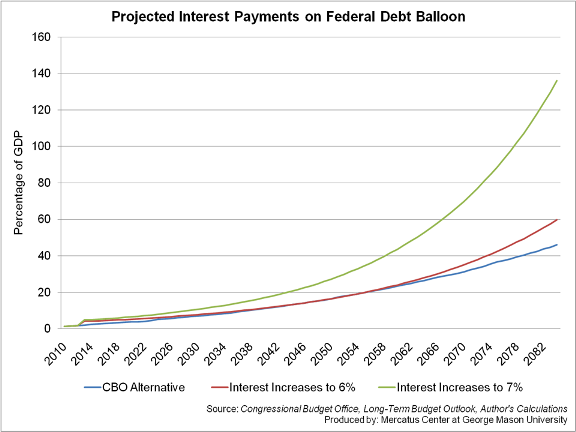
Kentuckians should be troubled by these developments.
De Rugy warned:
"Large and sustained deficits and debt inevitably cripple economic growth. The money the federal government borrows comes from Americans’ savings. So does the cash that Americans invest in private sector growth. There comes a point where there just aren’t enough savings to satisfy both masters. Unfortunately for economic growth, the government always helps itself first."
Did the KDE lose its dictionary?
Not only is the Kentucky Department of Education creating new categories of failure for schools and school districts (Restructuring - Yr 4, Corrective Action - Yr 5), it seems they are also creating new words...
Bluegrass Institute's Definition of "Goverence" from freedomky on Vimeo.
Attempt to repeal all right-to-work laws: Serious policy move or political stunt?

Kentucky is the only state in the federally designated "Southeast" without a right-to-work law.
However, if California Congressman Brad Sherman gets his way, not only will Kentucky never become a right-to-work state, but the 22 states currently with such a policy will lose that freedom.
Sherman has introduced legislation that would eliminate Section 14[b] of the National Labor Relations Act, which states:
(b) [Agreements requiring union membership in violation of State law] Nothing in this Act [subchapter] shall be construed as authorizing the execution or application of agreements requiring membership in a labor organization as a condition of employment in any State or Territory in which such execution or application is prohibited by State or Territorial law.The move is being applauded by AFL-CIO chief Richard Trumka. What a shocker.
Apparently, strategy is to try and sneak this through during the upcoming lame-duck session in Congress.
This may just be a case of Sherman opportunistically currying favor with his labor-union buddies. But with the current circus in Washngton, you never know.
One thing's for sure: Kentucky lawmakers should go on the offensive and pass a right-to-work law and reap the economic benefits enjoyed by our fellow southern states.
Monday, October 4, 2010
New Gallup Poll: Support for charter schools continues to grow in the US
The news release from Phi Delta Kappan about their annually conducted Gallup poll of the public’s attitudes on schools is out.
Though generally respected, this poll has been criticized in the past for possible bias towards the school teacher agendas (Phi Delta Kappan is a journal for teachers and is supported by teacher subscriptions).
So, that makes this finding, quoted from the news release, particularly noteworthy:
Support for charter schools growing. Americans increasingly embrace public charter schools. Sixty-eight percent of Americans have a favorable opinion of charter schools, and almost two out of three Americans would support a new public charter school in their communities. Sixty percent of Americans say they would support a large increase in the number of public charter schools operating in the United States.
Frankfort, are you listening?
Monday links
Some links to get your week started...
- Once again, Don Boudreaux makes me laugh audibly with another well worded letter...fantastic.
- Kentucky's U.S. Senate race got some national coverage with a televised debate on Sunday ...

- Cap and Trade: Here's a great, plain language explanation of some often discussed legislation.
Friday, October 1, 2010
Who Ya Gonna Call?
A commentator to one of my blogs this past week asked us about an incident in the Fern Creek High School in Jefferson County. The commentator was concerned because an incident involving a gun had not been reported to parents. The commentator wanted to know if the school had met legal requirements for reporting the incident.
That generated queries from me to both Marcia Seiler, head of the Kentucky Office of Education Accountability (OEA), and to Kentucky Commissioner of Education Terry Holliday. They both got back to me very quickly with information on this particular incident, which I have added in another comment to the blog linked above (the school did nothing improper).
However, the reason for this new blog is that I realized many people in Kentucky may not know where to go if they do want to anonymously report a potential issue with their schools.
So, here is some information from Ms. Seiler telling you how to communicate problems to her office and even do so anonymously if you so desire:
OEA has a webpage that the public can access to file a complaint. We take anonymous complaints, but the complaint must provide sufficient detail that OEA staff can determine the facts to investigate. General and broad complaints about a district, school or individual, without facts providing specific dates, schools or individuals, generally are insufficient for investigation. If the person provides a phone number or other contact information, OEA staff can contact them for additional information.
We do require the complaint be in writing (input via the web site meets this requirement), but they can also call us and discuss an issue with an investigator to determine if the matter is something we would handle. Sometimes, with a brief conversation, we are able to assist an individual with their issue without a full investigation.
The OEA website is: http://www.lrc.ky.gov/oea/
The OEA toll-free hotline is: 1-800-242-0520
Of course, if you bring an issue to us at the Bluegrass Institute, we’ll try to track down answers, as well. But, especially if something is time critical, taking the problem direct to an action agency is the best way to get fast service.
'One way' streets won't lead to better schools
Solving Kentucky’s education problems requires at least an average amount of common sense. Those determined to maintain the status quo fail that test.
Click here to read the latest Bluegrass Beacon.
Taxes, laughter, and grades...OH MY! Friday links!
- Duh... Donald Boudreaux makes me laugh.
- Property taxes in Fayette... In a rare move, the Fayette County School Board has decided not to increase property taxes for the next fiscal year. Wow. I must say, I am surprised at the restraint. According to Kentucky.com, Stu Silberman says this is an attempt to provide relief... In case you were wondering how your property taxes are assessed by local school boards, here's an explanation.
- Beshear gets a 'C'...The Cato Institute released the Fiscal Policy Report Card on America's Governors this week. Kentucky's own Steve Beshear received a score of 54 which was enough to get him a 'C'. Hmm. Below is a clip from the report about Gov. Beshear.


